
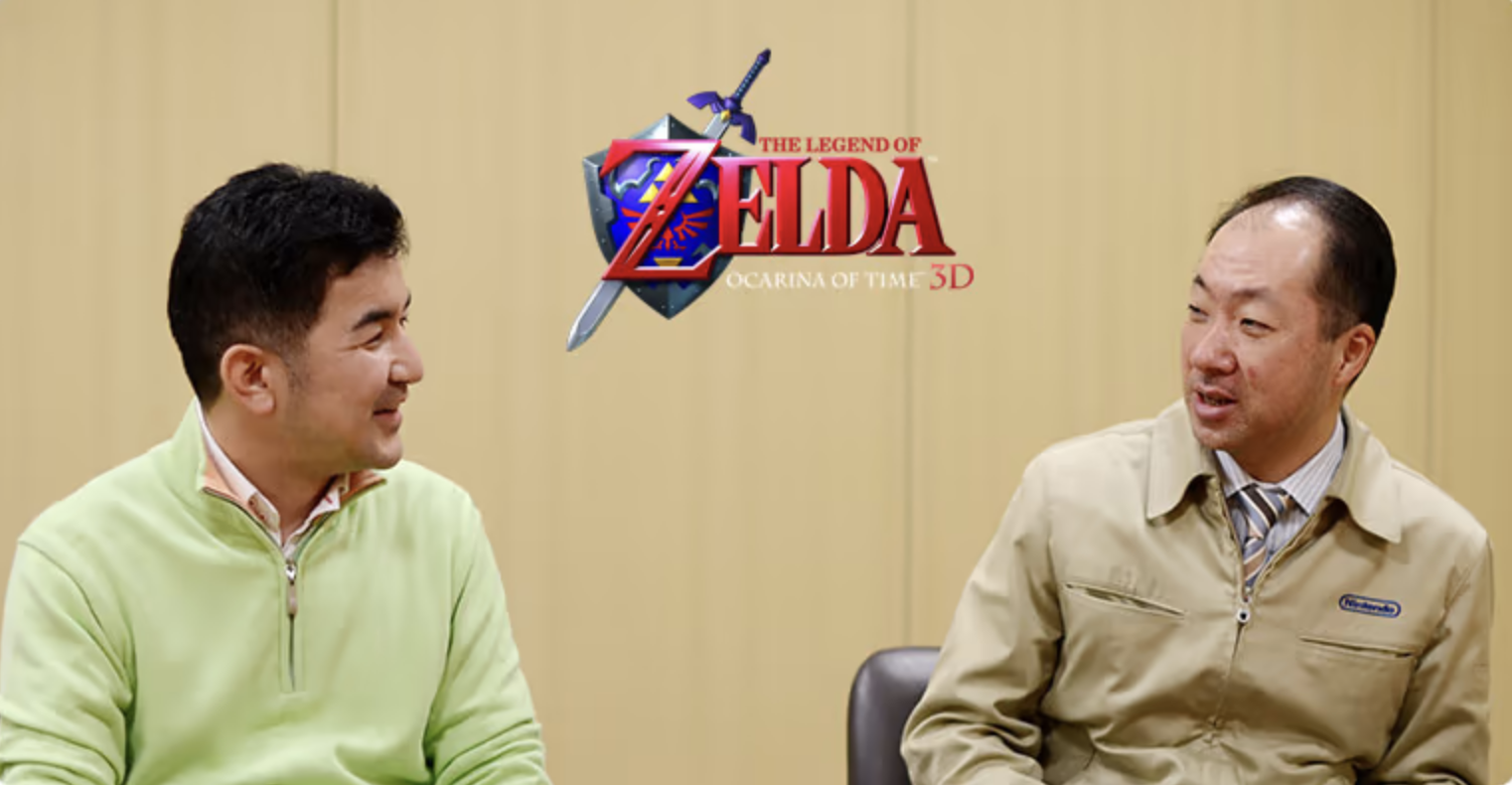
I've been calling it the "Koji Kondo sound font" since this Iwata Asks interview.
Now, before anybody comes for me, I want to be clear: I can't definitively prove that this was a sound font Kondo specifically requested or preferred. But there is some fascinating evidence that makes me wonder whether Kondo had a particular attachment to the N64 sound of Star Fox 64, Ocarina of Time, and Majora's Mask.
And it all comes from an interview surrounding the release of Ocarina of Time 3D.
"Stay Faithful to the N64 Sound"
In the Iwata Asks interview about the music of Ocarina of Time 3D, the developers discussed the game's dynamic music and some of the technological challenges involved in recreating it on the 3DS.
Mahito Yokota explained that they initially considered streaming the music because of the technological limitations involved in changing the music in real time to match different gameplay situations.
Instead, he decided to update the music and give it a more modern sound.
But halfway through the process, Koji Kondo stepped in and said: "Make sure you stay faithful to the N64 sound."
Now, when I first read that, my immediate interpretation was: Kondo wanted them to preserve the N64 sound font despite the 3DS being capable of much better sound library for the game.
But the more I thought about it, the more I wondered if there was another interpretation.
Maybe Kondo wasn't necessarily saying, "Use the exact same instruments." Maybe he was saying, "Don't lose the way this music functions."
And there's another part of the interview that makes this even more interesting.
The Forest Temple
One of my favorite pieces in Ocarina of Time is the Forest Temple theme. It's a hauntingly beautiful and atmospheric piece, and completely unlike anything else in the game. In another section of the interview, the developers specifically discuss the strange, almost shrieking sounds used in the Forest Temple music. Kondo wanted those sounds reproduced on the 3DS the way they sounded on the original N64.
That's significant.
Because if Kondo was simply concerned about preserving the interactive nature of the music, why specifically insist that those sounds remain faithful to the N64 version? It makes me wonder whether he really did have an appreciation for this particular sound font they developed for the N64.
And honestly, I get it.
The N64 Sound That Followed Kondo
Here's where my "Koji Kondo sound font" theory comes from.
The same general N64 sound palette appears across: Star Fox 64 → Ocarina of Time → Majora's Mask
Now, obviously, that's not proof that Kondo personally chose or demanded this particular sound font.
But it's interesting.
The technology was being used repeatedly, and each game expanded upon what came before.
Star Fox 64 came first.
Then Ocarina of Time expanded the sound library considerably. Then Majora's Mask continued using that foundation. The instrumentation is expanded on each entry. And Kondo was there throughout.
So perhaps he wasn't necessarily in love with the sound font itself. Maybe he simply loved what it allowed him to do in terms of interactive music.
The Interactivity Question
This is where I think the answer might actually be both.
One of the most interesting things about Kondo's N64 music is how interactive it could be.
Ocarina of Time doesn't simply play a song while you're running around Hyrule.
The music responds to what you're doing.
The Hyrule Field theme, for example, dynamically changes depending on what's happening around Link.
That was technologically impressive for the time.
So when Kondo told the Ocarina of Time 3D team to remain faithful to the N64 sound, perhaps he was concerned about preserving both the sound palette and the interactive design.
The Forest Temple example makes me think that's possible.
And that's why I don't think it's unreasonable to say that Kondo was at least a fan of what that N64 technology allowed him to accomplish.
What Does This Mean for the Ocarina of Time Remake?
I’m going to discuss this in another post in greater detail. And this brings me right back to the upcoming Ocarina of Time remake on Switch 2.
How are they going to handle the soundtrack?
We've already seen what Nintendo has done with Star Fox 64.
The new version features a fully orchestrated soundtrack, and it sounds fantastic. That gives us a potential preview of how Nintendo could approach the more orchestral portions of Ocarina of Time.
But Ocarina of Time is more complicated than simply throwing everything into an orchestra. There are plenty of tracks where live musicians, big-band arrangements, synthesizers, and other sounds could make more sense.
And then there's the question of interactivity.
How will they handle the Forest Temple?
How will they handle Hyrule Field?
I’m sure Nintendo will preserve the original interactive structure, it wouldn’t be the same without it, but I think more about exactly how they are planning on replacing the N64 instrumentation.
I don’t believe they will completely reinterpret the music.
I’m so curious how this score will be handled. I hope Kondo is 100% involved with it.
I Can’t Wait to Hear the Remake’s OST
The original Ocarina of Time soundtrack is one of the most iconic video game scores ever created.
So Nintendo has a difficult balancing act ahead of it.
Modernize it without losing its identity.
Give us the orchestral arrangements where they make sense. Use live musicians where they can elevate the music. But don't forget the strange, atmospheric, experimental sounds that made the original so memorable.
And if Koji Kondo really did have a special appreciation for that N64 sound font - or even just the technology that allowed him to make the music interactive - I hope Nintendo remembers that too.
Because when I hear that Kondo specifically told the Ocarina of Time 3D team to "stay faithful to the N64 sound," I don't think that was an insignificant comment.
Maybe my "Koji Kondo sound font" theory is wrong.
I can't prove it. I hope to ask him some day.
But the evidence is certainly interesting enough to make me wonder.
And now I'm even more curious to hear what Nintendo does with Ocarina of Time on Switch 2!